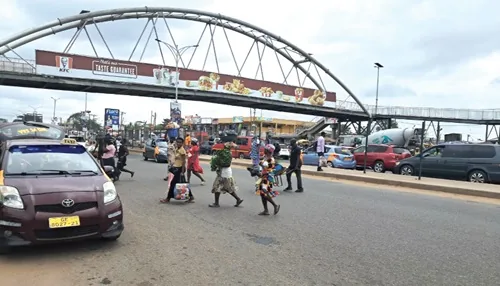
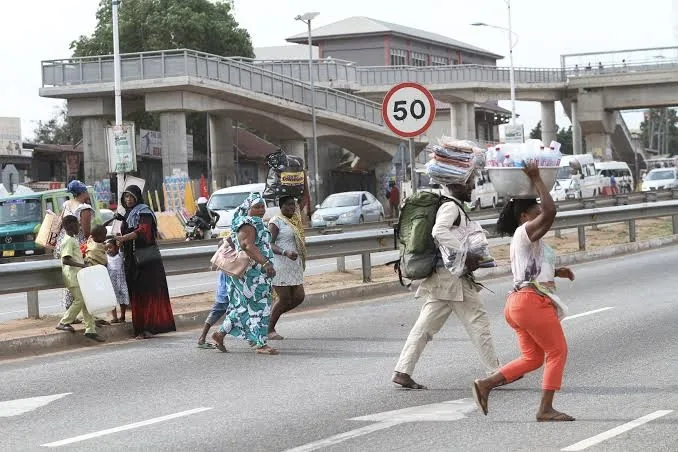
At interchanges across Ghana, the picture is almost always the same. A footbridge stands a few metres away. Below it, people wait for a gap, then pick their way through traffic.
It is not an isolated scene. From Accra’s busiest junctions to highways outside the capital, most pedestrians still cross at ground level. The overpass is there. The road is what they use.
The reasons are rarely dramatic. People say the bridge is too long, too high, or simply out of the way. Climbing it takes minutes. Darting across takes seconds. Traders with loads, workers late for a trotro, schoolchildren in a hurry — the calculation is the same. Convenience wins.
Researchers who have watched these crossings describe a stubborn pattern. Informal routes through the median are used more readily than the structure built for the purpose. Young pedestrians and men are often the least likely to climb. At some sites, people only use the bridge when police or city guards are standing at the bottom of the stairs. When the officers leave, the highway fills again.
Design plays a part. Some bridges sit far from the natural desire line — the place people actually want to cross. Others are poorly lit at night, or occupied by hawkers, which makes the walk feel slower and less safe. In a few places, residents have nicknamed long, winding spans after video-game obstacle courses. The joke is telling: the safe route feels like extra work.
Authorities have tried reminders, barriers and roadside deployments. The Motor Traffic and Transport Department is a familiar presence at new interchanges, turning people back towards the stairs. Assemblies have, at times, sent task forces to the same junctions. The compliance lasts as long as the uniform does.
Road safety officials point to the obvious risk. Ghana’s multi-lane highways leave little room for a missed step. Pedestrians account for a large share of traffic deaths, and many of those deaths happen while people are crossing. Drivers complain that a sudden figure in the road forces them to brake for someone who had another option a short walk away.
None of this is new. Footbridges have been demanded after crashes, built after protests, then quietly abandoned. The infrastructure is treated as a backdrop. The habit is the story.
That habit is now part of the landscape of Ghana’s interchanges: empty stairs, moving traffic, and a crossing that happens in the wrong place, again and again.