
South Africa has faced similar controversies in the past, involving ships that failed to perform as expected, aircraft that remained grounded, promised industrial offsets that never materialised, and procurement costs that were still paid. Critics have also argued that the term “modernisation” has sometimes been used to describe procurement processes that lacked transparency and efficiency. A similar debate is now emerging around one of the most basic pieces of equipment used by soldiers: the rifle.
The Vektor R4 and R5 rifles have served as the main weapons of South African infantry for more than 40 years. While the rifles are ageing and may require upgrades or replacement, the concern is whether the South African National Defence Force is considering replacing its locally designed and supported 5.56×45 mm rifle family with a Kalashnikov-pattern weapon, either imported or assembled locally, without a sufficiently thorough strategic and procurement process.
Armscor has issued Request for Information 02061-900-013 for Self-Loading Automatic Rifle Systems, with submissions closing on September 30, 2026. The organisation describes the process as an information-gathering exercise rather than a formal tender. However, concerns have been raised that such an exercise could eventually lead to a procurement programme.
The request covers a range of equipment, including an assault or battle rifle, a designated marksman rifle, ammunition, magazines, optics and local support. While such requirements are not unusual, the process has attracted attention because of reports linking it to the AK201 5.56 mm rifle and other Kalashnikov models, including the AK-15K, AK-19K, AK-203 and AK-204, which were also displayed in South Africa.
A written parliamentary question has been submitted asking the Minister of Defence and Military Veterans to clarify whether a decision has already been made to replace the R4 and R5 rifles with a Kalashnikov-pattern weapon. If no decision has been taken, the question seeks an explanation of the purpose of the RFI and why it is being viewed by some in the defence industry as the beginning of a replacement programme. If a decision has been made, further details have been requested, including when and by whom it was taken, which rifle and calibre are being considered, and what operational assessment supports the proposed replacement.
The debate also highlights the fact that replacing a rifle involves more than simply choosing a new weapon. Factors such as calibre, magazines, training, maintenance, spare parts, barrels, bolts, ammunition production and the local companies that manufacture components all have to be considered. The R4 is part of a broader South African industrial network, with local companies producing various components, including small but essential parts such as buffers and pistons.
Information currently circulating claims that 300 AK201 rifles were purchased for testing but have not yet been delivered. It also claims that any proposed local production arrangement could involve assembling some components in South Africa, while manufacturing certain parts such as barrels and bolts locally and importing receivers. Concerns have also been raised about possible supply disruptions linked to wartime production conditions.
The same information places the potential 30-year cost of the programme at around R1 trillion. However, these figures and claims still need to be independently examined and verified. Regardless of whether the estimates ultimately prove accurate, the concerns raised about cost, supply, local industry and the strategic justification for replacing the existing rifles require proper scrutiny.
A familiar and concerning pattern
Beyond concerns about the technical choice of rifle, questions have also been raised about the procurement process itself. Allegations of possible wrongdoing have reportedly been brought to the attention of the Minister. One of the claims is that a substantial amount of money was paid upfront to a supplier or consultant without a valid contract guaranteeing that the weapons would be delivered.
Such allegations are significant because similar practices have previously caused controversy in South Africa’s defence procurement system. Critics have raised concerns about situations where payments were made before goods or services were delivered, with terms such as “trials”, “facilitation”, “market testing” or “strategic partnership” being used to describe the arrangements.
Questions have therefore been submitted to the Minister seeking clarification on whether she was informed about the allegations, how much money was allegedly paid, who received it, when the payment was made, what contract or Treasury approval authorised it, and what goods or services were provided in return. The Minister has also been asked to confirm that all payments associated with the process were lawful and supported by valid contracts.
If those matters cannot be clearly established, there have been calls for investigative bodies such as the Special Investigating Unit and the Auditor-General to examine the process, with their findings presented to Parliament.
South Africa’s previous defence procurement controversies provide important background to these concerns. The Strategic Defence Package remains associated with disputes over irregular contracts, intermediaries, consultants and industrial offsets that were intended to support local industry. These controversies have contributed to public scepticism about major defence procurement programmes.
Denel has also experienced years of financial and operational difficulties, including liquidity problems, loss of specialised skills and delayed orders. Although the company has begun showing signs of recovery, concerns have been raised that a new rifle procurement programme could weaken the remaining local small-arms manufacturing network.
A possible local alternative has also been proposed. According to Denel engineers, an upgraded version of the R4/R5 could be developed and manufactured at a lower cost. The engineers have reportedly assessed the existing rifle to identify areas that could be improved, including reducing weight, improving the design and adding modern features while retaining compatibility with existing ammunition.
Another option involving CZ has also been discussed, including a proposal to purchase existing R4 rifles for recycling. However, this approach could also affect current South African suppliers. Each option would have financial and industrial consequences, making it important for the costs and benefits of the alternatives to be compared over both ten-year and thirty-year periods before a final decision is made.
The SANDF is operating under significant financial constraints, with limited resources affecting areas such as uniforms, aircraft availability, vehicle maintenance and support for military veterans. Against this financial backdrop, replacing the country’s existing rifles would represent a significant strategic expenditure rather than a routine purchase.
The key issue is therefore whether a rifle replacement would form part of a broader and clearly defined defence strategy, or whether the procurement process is moving forward without sufficient evidence of how the expenditure fits into the SANDF’s wider priorities.
A strategy adopted by Cabinet but not yet made public
The document intended to guide major defence decisions is known as Journey to Greatness. Cabinet adopted this long-term strategy for the development of the defence force at its meeting on May 6, 2026. The decision was confirmed in an official Cabinet statement released on May 9 and was later confirmed in Parliament by the Minister of Defence and Military Veterans.
However, Cabinet’s approval does not conclude the parliamentary process. The strategy remains confidential, and Members of Parliament have only received information about it through closed briefings involving senior SANDF leadership. Such confidential briefings do not provide the same level of transparency as making the full document available for parliamentary examination, public scrutiny and detailed costing.
The central issue is that Journey to Greatness is expected to eventually be presented to Parliament as a public document. Parliament would then be able to examine and formally adopt the strategy. Until that happens, the public is being asked to accept that major defence programmes with significant financial implications are consistent with a strategy that Cabinet has approved but that has not been made available for public examination or parliamentary adoption.
The proposed replacement of the SANDF’s service rifles should therefore not be considered separately from the wider defence strategy. Whether the country chooses to upgrade the R4/R5 family, restore local production or acquire an imported Kalashnikov-pattern rifle, the decision would need to take into account the overall design of the armed forces, ammunition standards, local industrial capacity, training, maintenance and the Defence Force’s available budget.
These are strategic considerations rather than simply choices between products. They should form part of a broader defence strategy that Parliament has had the opportunity to examine, debate and adopt, rather than being addressed separately through confidential briefings and an Armscor information request.
Concerns have consequently been raised about the gap between the Cabinet-approved strategy and parliamentary oversight. While the RFI may comply with existing procedures and the display of Kalashnikov-pattern rifles in South Africa may be a normal commercial activity, critics argue that the combination of the RFI deadline, an allegedly undelivered trial batch, claims of an advance payment without a valid delivery contract and the continued confidentiality of Journey to Greatness warrants closer scrutiny.
What could happen next
The argument is not necessarily that the R4 should remain unchanged. Instead, proponents of the existing platform argue that it should be upgraded where doing so would be more affordable, strategically appropriate and supportive of local industry. This could include restarting production at Lyttelton, retaining specialist local companies with experience in the weapon and using Denel engineers to develop improvements.
If testing ultimately shows that a foreign rifle offers significant advantages, the comparison could be conducted through transparent and comparable trials. This would involve assessing factors such as calibre, the justification for any change in calibre, total life-cycle costs and the extent of local participation.
The broader argument is that any rifle replacement should follow a clearly defined procurement process. Payments should be supported by valid contracts, contracts should be based on verified military requirements, and those requirements should form part of an established force design and defence strategy.
Until Journey to Greatness is made available for full parliamentary consideration and adoption, questions will remain about how individual defence procurement decisions are being linked to the strategy. Given South Africa’s previous controversies surrounding defence procurement, the article argues that greater transparency and parliamentary oversight are necessary before a major decision on the SANDF’s service rifle is finalised.
South Africa faces potential rifle replacement controversy amid allegations and strategic challenges
Written by
Korley Precious Naa Kordey
8 min read
The headlines, by email.
A short digest of what matters across Africa. Free, and you can leave whenever you like.
We send a confirmation link first, and never share your address.
More from Governance

Madina MP Francis-Xavier Sosu doing well after GIMPA incident, office says
The Member of Parliament for Madina, Dr Francis-Xavier Sosu, is doing well after becoming unwell during a speech at the Ghana Institute of Management and Public Administration (GIMPA) in Accra on Thursday. Dr Sosu was addressing an audience when he suddenly appeared to lose consciousness and coll...
Governance
U.S. Allocates $1.5 Million to Mozambique for Weapons Control Efforts
Maputo — The United States government has committed $1.5 million to support Mozambique in improving the management and security of its weapons and ammunition. The funding forms part of a broader initiative aimed at enhancing national security. Implemented in partnership with The HALO Trust USA, t...
Governance
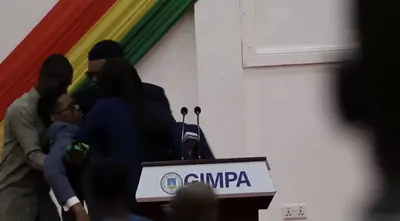
Francis-Xavier Sosu Collapses While Speaking at GIMPA
Ghanaian lawmaker and Madina MP, Francis-Xavier Sosu, reportedly collapsed while speaking at an event at the Ghana Institute of Management and Public Administration (GIMPA) in Accra on Thursday, September 24, 2026. Sosu was addressing attendees when he suddenly appeared to lose consciousness and...
Governance